
Description
gvSIG is a Geographic Information System (GIS), that is,
a
desktop application designed for capturing, storing, handling,
analyzing and deploying any kind of referenced geographic information
in order to solve complex management and planning problems. gvSIG is
known for having a user-friendly interface, being able to access the
most common formats, both vector and raster ones. It features a wide
range of tools for working with geographic-like information (query
tools, layout creation, geoprocessing, networks, etc.), which turns
gvSIG into the ideal tool for users working in the land realm.
gvSIG is known for:
- integrating in the same view both local and remote
data
through OGC standards.
- being designed to be easily extendable, allowing
continous
application enhancement, as well as enabling the development of
tailor-made solutions.
- being open source software, under GNU/GPL license,
which
allows its free use, distribution, study and improvement.
- being available in several languages (Spanish,
English,
German, French, Italian,...) .
- being developed using Java, and being available for
Linux,
Windows and Mac OS X platforms:
|
- Fully rich GIS desktop client
- Licensed GNU/GPL
v2
- On strong delevolpment
- Interface translated into more than 10 languages
- Platform independent: runs on Microsfot Windows,
GNU/Linux and MacOS
- Modular: developed using independent
modules adding scalability value.
- Standard compliant: Open Geospatial Consortium (OGC)
- Developed
with INSPIRE
principles in mind
- Provides the most common GIS tools like data loading,
map
navigation, query map information like alphanumeric information,
distance measurement, thematic cartography, legend edition using the
most common legend types, labeling, feature selection by many selection
types, data tables with statistics, ordering, table relations, table
linking, layout manager, geoprocessing tools, CAD, raster processing,
etc.
- Interoperable: able to work with most of the known
data
formats:
- raster :
ecw, ENVI hdr, ERDAS img, (Geo)TIFF, GRASS, ...
- vector & CAD:
shapefile, GML, KML, DGN, DXF, DWG
- databases: PostGIS,
MySQL, Oracle, ArcSDE
- remote: ECWP, ArcIMS
- Its SDI client condition permits the connection,
through
the use of standardADL, s
- WMS
- WFS (and WFS-T)
- WCS
- WMC
- Discovery services client is also provided within
gvSIG which
can
be use to localize data resources within an SDI (catalogue
and gazeteer
services)
- Catalogs: Z3950, SRW, CSW (ISO/19115 and ebRIM)
- Gazetteers: ADL, WFS, WFS-G
|
- Geoprocessing tools:
- proximity: buffer, spatial join
- overlay: clip, difference, intersect,
union
- other: convex hull, reproject, ...
- Integrated advanced CAD tools:
- functionality for vector data
edition: modify, create and delete elements
- command console typical element in CAD software
- tools like help tools, grid tools, command stack,
complex element selections
- tools for inserting elements like points,
polygons,
lines, ellipses, etc...
- tools to modify its rotation, symmetry,...
- Integrated advanced raster tools:
- georeferencing images, set image transparency,
adjust bright and
contrast, highlight, etc.
- the SEXTANTE
Extension of gvSIG is already
available to download, including functions oriented to morphology and
hydrology fields,
- Advanced functionalities like
- Scripting support
- Powerful reprojection engine (PROJ4 wrapper)
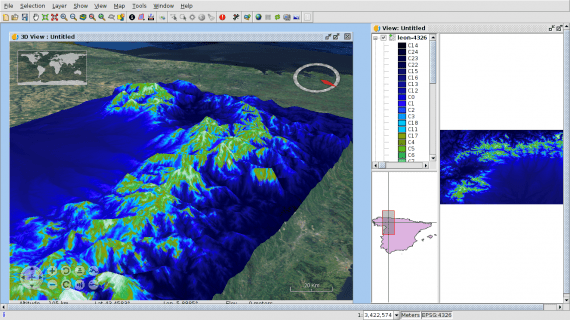
- 3D visualization
- Network analysis
- New raster analysis features like classification,
rectification,...
- gvSIG for mobile devices
- Next functionalities
- Publishing extension
- Geocoding and normalization
- Reports and charts
- See the available
roadmap
|